Search This Blog

Monday, 29 July 2013

The patter of tiny feet in felt

It's been a while since I have made some work that is for 'the little people'.
I forgot how much I loved working on this scale.
A local request for a special one year olds birthday was the starting point.
A new camera and some time to make and document and a help to those out there who are getting to grips with the wonderful creative craft of feltmaking.
silk is laid on black plastic resist. Note both slippers are made at the same time.

Three different pairs of slippers laid out in varying colours

tools for the work in hand

This shows the first layer in the pink wrapped over both sides of the resist. The sage colour shows the process before folding over ready for layer two

Pink and blue fluffiness with the outside layer

Having repeated the stages of layer one the slippers have a thin layer of silk on top for strength and design and get rolled in a bamboo blind

The booties get rolled until they shrink on the resist. Attention is paid to the edges t avoid ridges 

preparing the wool for lace cords

The corded laces which are then wet felted 

The slippers after being cut out and shaped on the resin or wood forms ( see above picture)
At this point I latex the soles to come over the heel and the front of the toe . This assists the baby in crawling and the early walking stages

The finished baby booties ready to be danced in.

Friday, 24 May 2013

Wool and Gardening

these wonderful plant tubs are water tanks , plenty of stone in the bottom
What has wool and gardening got in common?

 For some of us an outdoor play area.

This morning I have had my crochet hook in hand and have been busy planting a beautiful gift of beans along with my sprouted peas.

 Support needed and inspired by the book 'crochet saved my life'
A professional /personal perspective on the curative therapy of this textile skill.

So much for the government trying to declassify craft!!!!!


I set out with a crochet hook and  a few' lounging about ' balls of wool and have started the frame work.
creel with planters

Simple stitches make a sound framework
It will be an ongoing project...any  wild crochet people out there are welcome to come and make their imprint ...all in good fun and of course supporting the plants.


Connecting  loops with old coarse wool with plenty of lanolin left in it 

Thursday, 16 May 2013

Crafts know no boundaries, language of wool

What a busy time Heartfelt Studio has had over this last month.

Behind the scenes there is much development of new ideas and new skills.


This month three new artists made their début at Heartfelt Studio.
Through networking with international groups we shared a wonderful event here at Dalmally Railway Station.


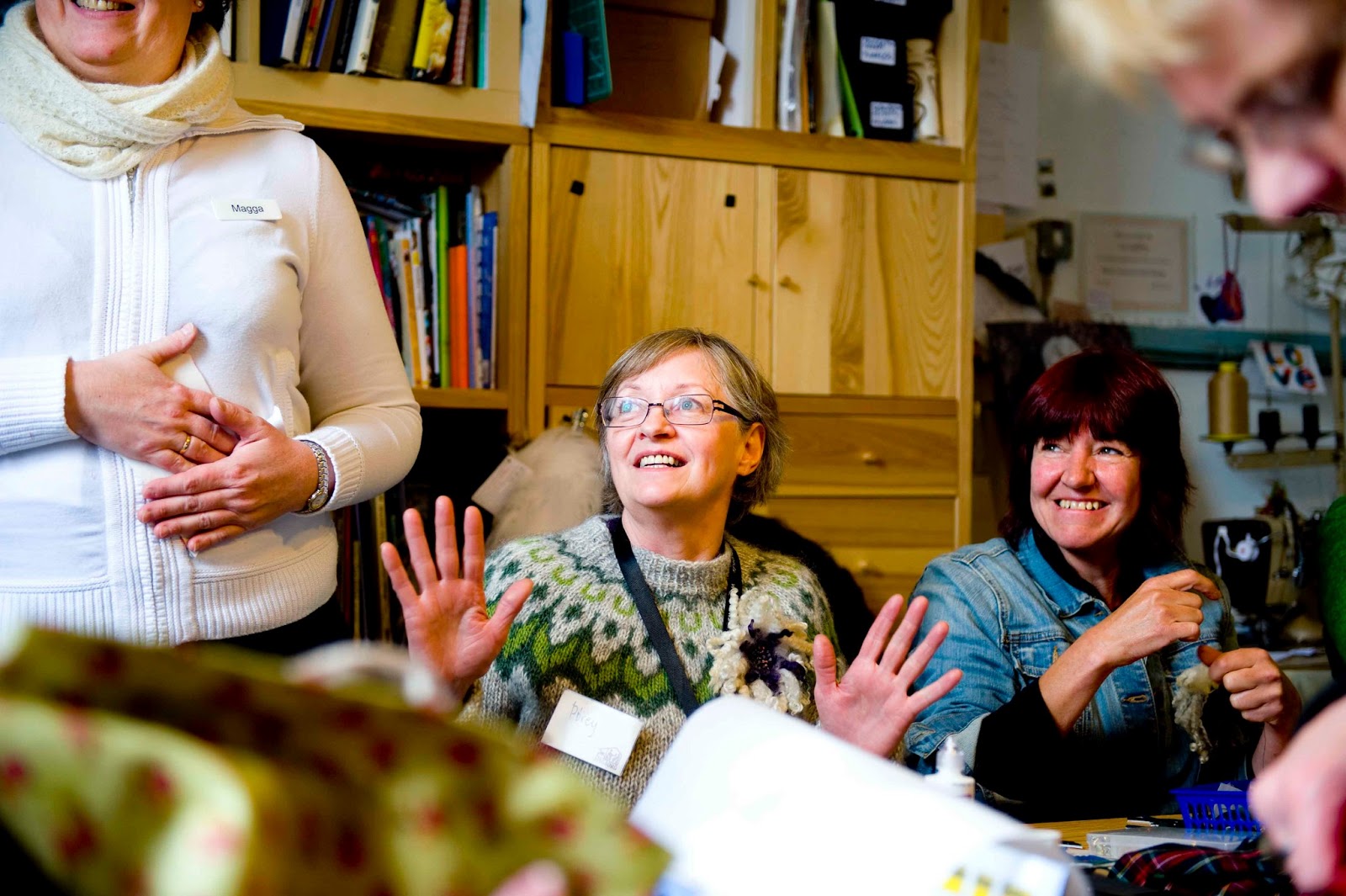
For two whole days 28 Slovak and Icelandic students worked with native wools and woven tartans to learn techniques such as wool preparation,  natural dying using native plants, nuno felting with recycled blankets and creating modern designs for sustainable small scale rural business.

Everyone had an opportunity to try all of the workshops and created a keepsake of their visit. A tall remit with a big cross range of skills and ages. Ann Ross, Gina Lawson , Lesley Convery and myself rose to the challenge and provided fun in a great learning environment. The attentive Graham saw to the refreshment needs and any difficulties that arose.

The platform at Dalmally Station rang out with laughter and sharing and we all had a delightful two days.

We learned much too as some very talented men and women shared their speciality in a variety of crafts.


Friendships have been forged and a hunger raised to visit both countries where these generous natured people live.


The platform had a series of felted banners loaned by the Scottish Feltmakers and made by the community of Scottish felt artists and were much admired by not only the attendees but also all the train passengers travelling between Oban and Glasgow.  A wonderful experience all round . New life has defiantly come to Dalmally.


 With some national costumes to inspire us. Such talent amongst us.

A special couple in national dress, they taught us much 

Such a broad smile and talented hands, how could we not love her...


.


Monday, 29 April 2013

Jacob wool sampling and testing

An amazing looking hardy sheep. The Jacob
As a textile artist working in a renewable sustainable medium I feel it is important to work as close to the source of my materials as possible. Argyllshire is certainly sheep country and I have been very fortunate to make some great contacts and lovely friends through networking.
Through the LORN or local origins rural network I have come in contact with many breeds of sheep.

An important thing to remember is that no two sheep are alike even in the same breed.
Lambs wool of course is softer than an old ewes wool but even between the different breeders the same breed can yield very different qualities of wool.

Many small holders have a better idea of their own sheeps wool as often they keep the sheep to use the fleece but their interest in the end product may be different from yours.
My advice? Sample sample sample. This is the only way you can tell what a fleece will do in the feltmaking process and even then it will always throw in some suprises.
There are some simple guidelines
1 . Know what your end product is going to be . Does it need to be hard wearing ? How well felted will it need to be to hold its shape.
2. How much will it shrink? A test piece is essential before you embark on any big project.
3. How many layers will you need, what quantity of wool will it take.

A little preparation will make a whole difference to the process as well as the end result.

Today I have been sampling the lovely Jacob fleece from Kintaline Farm in Benderloch. Jill and Tim have a very healthy herd of Jacob and some blue faced Leicester crosses ( fab fibre mix)


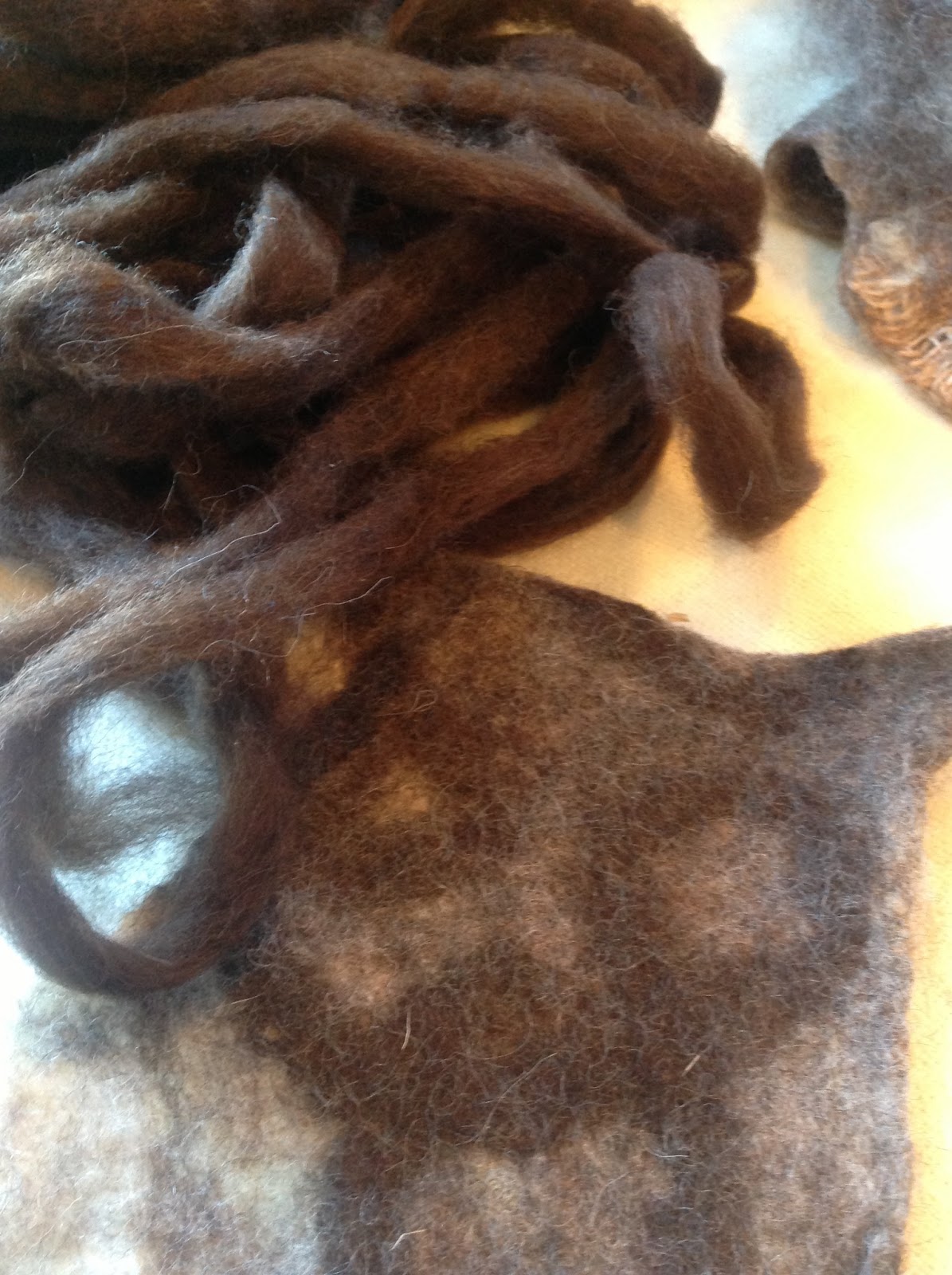
To act as a guide line a sample has been made of the generic black Jacob tops (carded in one direction )
Kintaline wool is presently send to a mill to be carded into batts ( multi directional layers of fibres)


The photos show how much kemp hair is in the commerical tops . The pale brown has been processed into rovings ( lightly twisted lengths , ideal for spinning directly from and perfect for decorative surface work on felt)


Black Jacob commercial tops. Note black wool is really a dark brown
What am I going to make?
Looking at then end felted samples, I defiantly prefer the Kintaline to the generic tops available from my supplier. Jacob has a slightly spongy handle when felted and is a little too hairy for much of my fine work but it is perfect for hard wearing items such as boots , coats or bags. Needle felting it is wonderful as well as sculpting with it.
Thumbs up for local Jacob fibre.

roving felted onto the surface of the carded batt


rovings and carded fibre

Tuesday, 9 April 2013

Why I choose to live in beautiful Scotland

A day of busman's holiday today...no that should defiantly read trains man holiday.
Investigating the train stations have been a great cause for a road trip and this is a taste of where we have been and some of the most varied and spectacular scenery in a short period of time.

 Iconic hint

 Silver white sands...the tropics or the west coast of the highlands!


 So love this ...think I can see the model here for the next photo shoot Graham Campbell!
The lovely Glenfinnan

Monday, 4 March 2013

Heartfelt by Liz: My table overfloweth with colour...

Heartfelt by Liz: My table overfloweth with colour...: Wool orders are always exciting to get into stock but there are times something new or something a little special comes in. Today I am inspi...

My table overfloweth with colour...

Wool orders are always exciting to get into stock but there are times something new or something a little special comes in. Today I am inspired and enthralled by the riot of colour I now have surrounding me.
Loop mohair has always been a favourite of mine for texture and interest. It felts into landscapes beautifully and some of the colour combinations I can already see as wraps in scrumptious colour.
This is the time I wish my knitting skills were better than they are but then each one of us has a skill in particular areas , this is why I felt.

I will have these skeins of loveliness for sale at Heartfelt Studio here in Dalmally Station, if of course I can part with them. Therein lies the danger of the textile artist.